
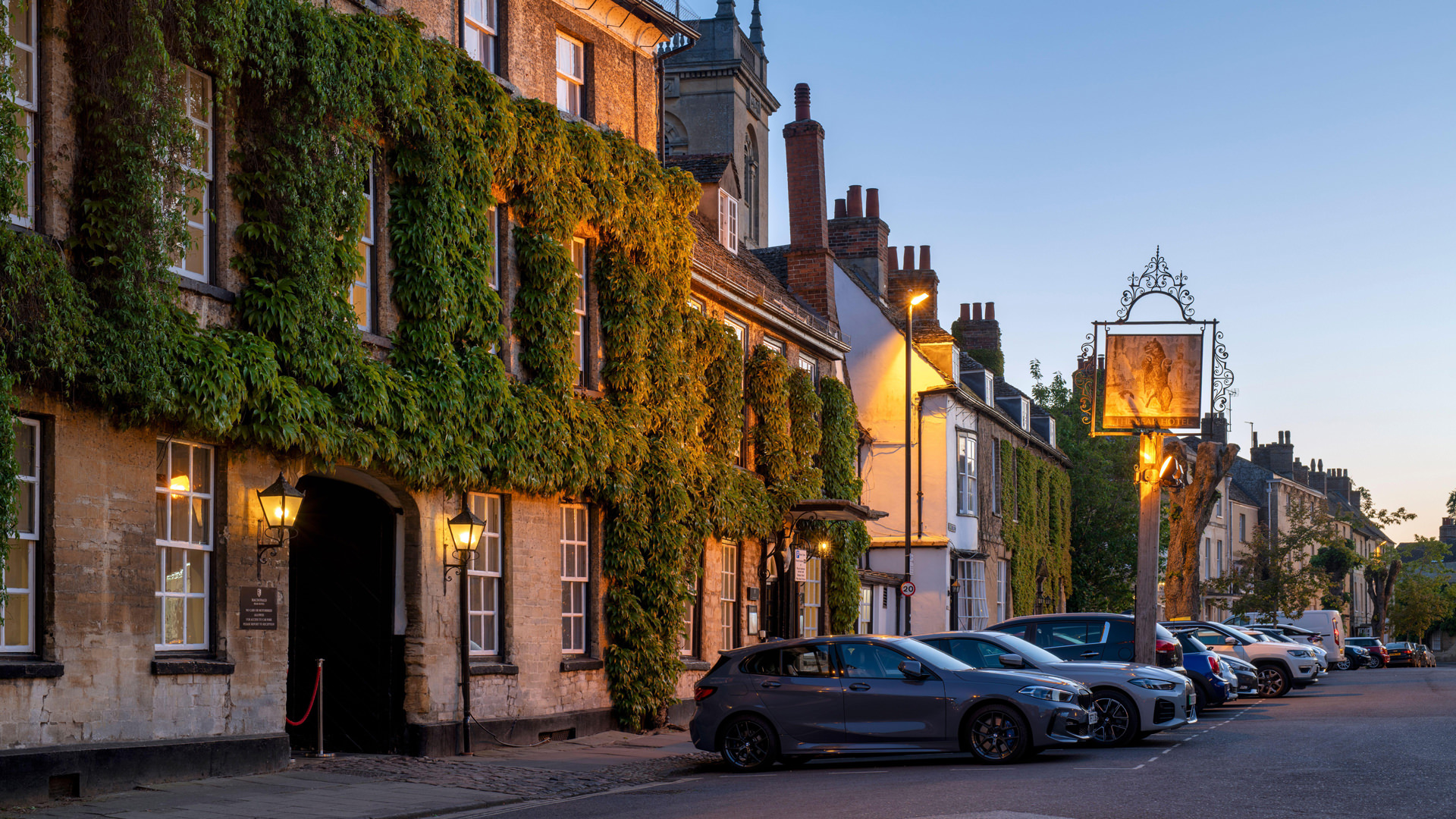
Woodstock has one of England’s grandest palaces on its doorstep, while neighbouring Kidlington quietly claims the title of the country’s largest village.
Woodstock and Kidlington sit a few miles apart on the eastern edge of the Cotswolds, just north of Oxford, and between them cover a genuinely wide range of what this part of Oxfordshire has to offer. Woodstock is the grander of the two by far: a handsome stone town built on the glove trade and now permanently associated with Blenheim Palace, the only non-royal, non-episcopal house in England to carry the title “palace” and the birthplace of Winston Churchill. Kidlington, by contrast, is a large and practical village that grew through the twentieth century to become one of the biggest in the country, useful as a base rather than a destination in its own right. This guide covers both, from Blenheim’s grounds to Woodstock’s own history and how the two fit into a wider stay near Oxford.
Woodstock and Kidlington at a Glance
| Location | Oxfordshire, on the eastern edge of the Cotswolds, around 8 miles north-west of Oxford |
| Known as | Home to Blenheim Palace and Winston Churchill’s birthplace |
| Distance from Oxford | Around 8 miles; about 20 minutes by car |
| Distance from London | Around 65 miles; roughly 1 hour 30 minutes by car |
| By road | On the A44, with the A34 and A44 linking to Oxford and the wider Cotswolds |
| Best known for | Blenheim Palace, Woodstock’s glove-making history and Georgian streets, and Kidlington’s size and practicality as a base |
Exploring Woodstock’s Streets and the Oxfordshire Museum
Woodstock’s town centre is built almost entirely from the same honey-coloured stone as the rest of the Cotswolds, its prosperity resting for centuries on the manufacture of fine leather gloves — a trade that boomed after Blenheim Palace’s completion in 1722 brought a steady flow of nobility through the town, and that at its peak supported up to ten small glove factories. That history is told in detail at The Oxfordshire Museum, housed in Fletcher’s House in the centre of town, alongside the wider story of the county. Nearby, the Town Hall, designed by Sir William Chambers in 1766 for the 4th Duke of Marlborough, remains one of the town’s most handsome public buildings.
Where to Eat and Drink in Woodstock
Woodstock’s dining punches well above its weight for a small town, largely thanks to one address.
- The Feathers Hotel, on Market Street, holds a Michelin Key and runs two distinct dining rooms: The Nest, a seasonal modern European restaurant open for dinner from Wednesday to Saturday under head chef Luke Rawicki, and The Aviary, a newer, more relaxed bar serving sourdough pizza in its courtyard.
- Beyond The Feathers, Woodstock’s town centre holds a further scatter of independent cafés and pubs, well placed for a stop before or after a visit to Blenheim.
For a wider view of dining across the region, the best restaurants in the Cotswolds sets Woodstock’s options in context.