
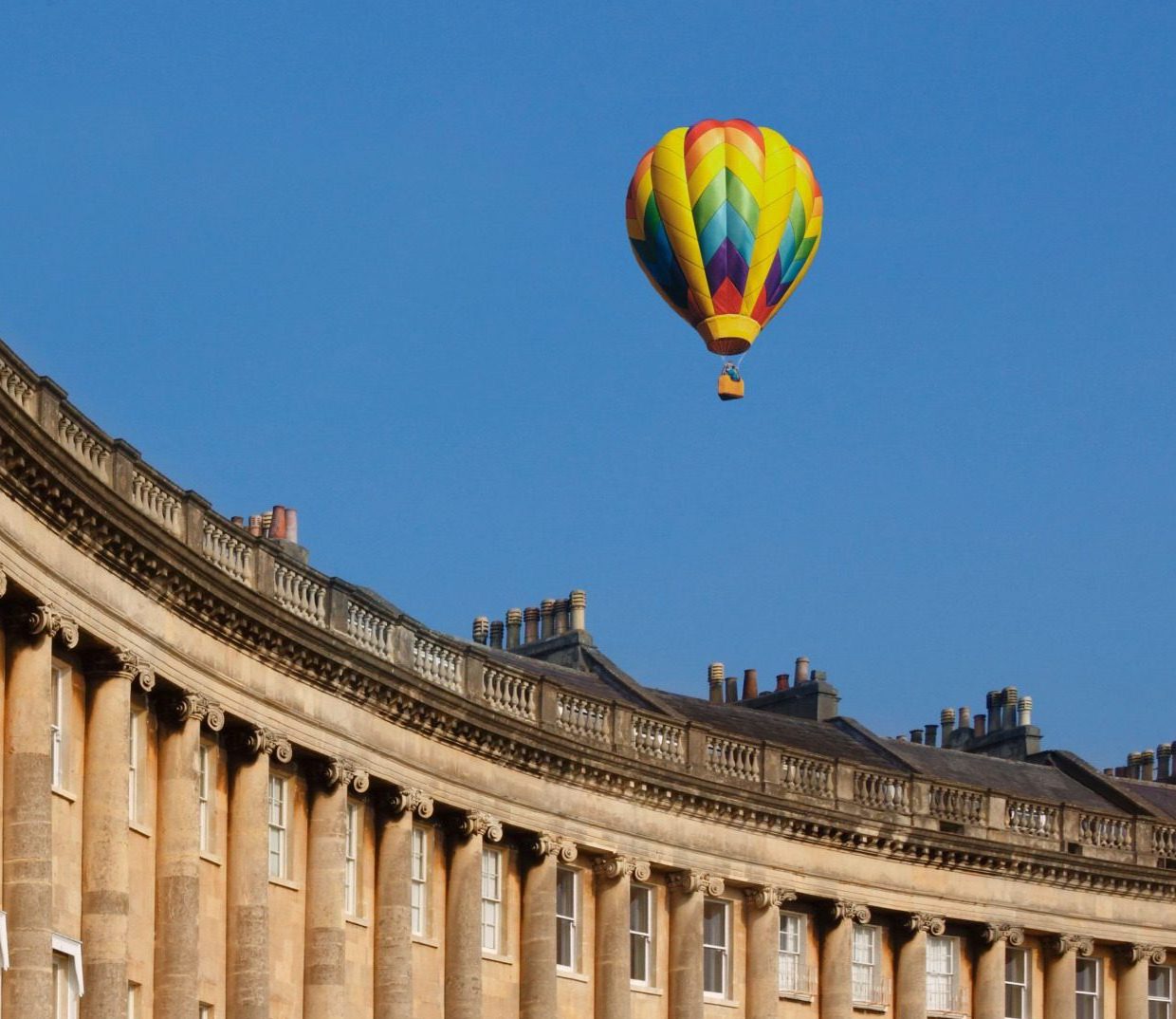
Bath sits just south of the Cotswolds proper, built around the only hot springs in Britain and shaped, in turn, by Roman engineers and Georgian architects into one of the most complete historic cities in the country. Its Roman Baths and Georgian crescents were both inscribed as a UNESCO World Heritage Site in 1987, and the city remains genuinely alive with both: the same springs that fed Aquae Sulis two thousand years ago still supply Thermae Bath Spa today. This guide sets out what makes Bath worth building a visit around, from its Roman and Georgian history to where to eat and how it pairs with a wider Cotswolds stay.
Bath at a Glance
| Location | Somerset, on the River Avon, at the southern edge of the Cotswolds |
| Known as | Britain’s only natural thermal spa city, a UNESCO World Heritage Site |
| Distance from Bradford-on-Avon | Around 8 miles; about 20 minutes by car |
| Distance from Cirencester | Around 30 miles; about 50 minutes by car |
| Distance from London | Around 115 miles; about 1 hour 25 minutes by direct train from Bath Spa station |
| Best known for | The Roman Baths, the Royal Crescent and the Circus, Pulteney Bridge, and Thermae Bath Spa |
Exploring Bath’s Roman and Georgian City
Bath’s history begins with its springs. The Romans built the temple and bathing complex of Aquae Sulis around the city’s naturally hot mineral waters, and the Roman Baths remain one of the best-preserved Roman remains anywhere in the world, drawing millions of visitors each year. Beside them, the Pump Room, dating from the Georgian era, was once the heart of the city’s fashionable social scene, its Corinthian columns and chandeliers still presiding over afternoon tea today.
Bath’s Georgian rebuilding, driven by the architect John Wood the Elder, the property developer Ralph Allen and the master of ceremonies Beau Nash, transformed the city into one of the most elegant in Europe. The Circus, built between 1754 and 1766, and the Royal Crescent, completed by John Wood the Younger in 1775, remain the city’s grandest addresses — Jane Austen’s aunt lived at number 12 Royal Crescent, and Austen herself, who lived in Bath for several years, used the Crescent as a setting in Persuasion. Number 1 Royal Crescent is now a museum recreating an eighteenth-century Bath household. Down by the river, Pulteney Bridge, designed by Robert Adam and opened in 1774 to connect the city to land the wealthy Pulteney family wished to develop, is one of only four bridges in the world lined with shops across its full span on both sides.
Where to Eat and Drink in Bath
- The Olive Tree, at The Queensberry Hotel, is Bath’s only Michelin-starred restaurant, holding its star since 2019 under chef Chris Cleghorn, with a refined, contemporary approach to seasonal British ingredients.
- The Scallop Shell, a well-regarded seafood restaurant, is known for fresh fish and shellfish in a relaxed setting.
- Raphael, a family-owned restaurant with nearly four decades in the city, draws on classic French haute cuisine with contemporary touches.
- Just outside Bath, Restaurant Hywel Jones, at Lucknam Park, has held a Michelin star since 2006, making it a worthwhile detour for a special occasion meal.
For a wider view of dining across the region, the best restaurants in the Cotswolds sets Bath’s options in context.
Bath’s Cultural Life: Theatre, Music and Festivals
Bath’s cultural life runs well beyond its museums. The Theatre Royal Bath, one of the oldest and most beautiful working theatres in Britain, survived the Blitz largely intact and was rescued as a charitable trust in 1979 by Jeremy Fry, before a 1980s restoration by designer Carl Toms reopened it with a gala performance attended by Princess Margaret. Alongside its Georgian Main House, the theatre now runs the Ustinov Studio for new writing and the egg, a dedicated theatre for children and young people — genuinely rare provision for a city of this size. Theatre Royal Bath Productions, the theatre’s own commercial arm, has produced more than 200 plays since 1998, sending over 40 of them on to the West End.
The Holburne Museum, at the top of Great Pulteney Street, anchors much of the city’s festival calendar, hosting events for the ten-day Jane Austen Festival each September, including the Grand Regency Costumed Promenade, in which up to 500 costumed guests process from the museum, over Pulteney Bridge and through the city centre. Bath’s music scene runs from the multi-arts Bath Festival each May, with well over a hundred events across the city, to the more specialist Mozartfest and Bachfest — dedicated classical music festivals with a genuinely serious international following.
Destination Shopping: Antiques, Books and the Artisan Quarter
Walcot Street, known locally as the Artisan Quarter since the 1960s, is the city’s bohemian heart — a run of independent galleries, vintage and antique shops, ceramicists and small workshops, its Saturday flea market drawing collectors for antiques, books and curios. Bartlett Street Antiques Centre, one of the largest of its kind in the West Country, gathers fine art, Asian art, jewellery, glassware and silverware from dozens of dealers under one roof. For books, Mr B’s Emporium on John Street has twice been named the UK’s best independent bookshop, known as much for its personalised “reading spa” recommendations as for its stock. Bath’s shopping has a character quite distinct from a typical high street, and this artisan quarter is where that character shows most clearly.
Sport in and Around Bath
Bath is a genuinely serious sporting city, and much of that life is visible rather than hidden away. Bath Rugby, founded in 1865, has played at the Recreation Ground — universally known as the Rec — since 1894, its riverside setting beneath the Georgian terraces giving it one of the most atmospheric match days in English rugby. On Lansdown Hill above the city, Bath Racecourse claims a genuine distinction: at 780 feet above sea level, it is Britain’s highest flat racecourse, with a racing history at the site stretching back to 1728. Golfers are equally well served, with Bath Golf Club (established 1880) and Lansdown Golf Club (established 1894) both ranking among the West Country’s oldest and best-regarded parkland courses.